
Introducing the Grounds: Common Groundskeeping #1

Updated: Mar 5
Hello World!
My name is Hunter Silvestri, and I’m the garden manager here at the Azalea Garden. This year, it’s my intention to bring you behind the scenes of our unique public garden through original writing, photography, and interviews.
The plan is to put out one of these posts every month* in 2026 (* weather permitting, as we say). Common Groundskeeping may span a number of topics, from progress reports to local history, from ecological field notes to gardening tips, from photo diaries to conversations with experts. We’ll find out together!
To kick things off, I’d like to bring you an introduction to the garden and the work of groundskeeping, filtered through my perspective as a longtime residential landscaper in the area.
~
I’ve dug around in yards all over the state—not to mention a few out west—and I can safely say two things:
Everyone’s yard is unique.
No one’s yard is as unique as this one.
The Kinney Faella Azalea Garden is located on a 16 acre plot on Kingston Hill, at the intersection of routes 138 and 108. The property has an unpredictable shape, and touches the road in five separate points. Seen from above, it looks to me like a mammoth.

When you enter, your eye is pulled at once to the moon gate, a marvelous 1989 installation which rises organically from an old stone fence which I presume has been in place since the sheep days of the long 19th century.
To your left, the North: wet meadow and fen, a swale-fed vernal pool, a jungle of rhododendron, and Galle’s Footsteps.
To your right, the south: towering hemlock, rows of nursery younglings, a canopy of beetle-bitten ash, and a moss-carpetted labyrinth of leucothoe and pepperbush.
Straight ahead, East: wildflower, then rock, then woodland all the way down to the Saugatucket where I was raised.
To your back, West: the old house, and the road back to civilization.
And everywhere, everywhere, everywhere: the azaleas. Some tall as trees, some low as grass; some from Japan, some from Louisiana, some invented here on these grounds; all thriving in their slow way from out of the glacial till. In spring, it is a cacophony of color.
But I joined the team in August.
~

Summer in New England is a sea of green undergrowth as the plants push frenetically away from the hot earth, siphoning all their power upward to their fruits as the summer’s long days grow shorter.
All our famous Ericaceae specimens - the azaleas and rhododendrons - were past their petals and already beginning to set new green buds for next spring’s bloom.
Meanwhile, hundreds of less famous Flora - some native like the annual jewelweed the hummingbirds so love, others invasive as the dreaded border privet once planted by shepherds as a living fence - were racing to choke out our labyrinth of trails.
This was the scene of my first weeks as the new steward of our 16-acre Eden.
After the years I’ve been working in this field, I knew some thing going in: that the that the ticks would be hungry; that the air would first be too hot, then too cold; and that while I would likely see neither bobcats nor spirits on the grounds, I would feel their eyes on the back of my neck every day as I worked, their silent message loud: we live here, man! don’t screw it up.
~
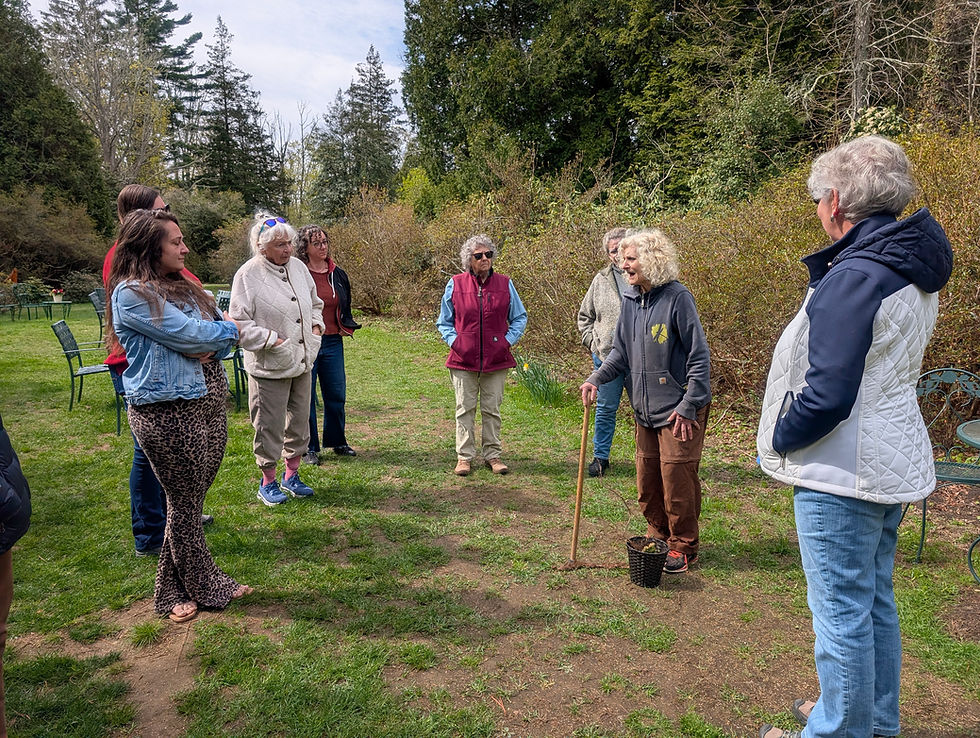
What I could not have known going in was the peculiar joy of work on a public garden. At one time, decades back, this was just another backyard. But today, it is an intricate community: of friends, of strangers, of flowers and wild beasts.
Small moments add up:
Seeing Shawndavid turn a block of deadwood to an angel with his chisel;
Learning from Sue how to see the subtle signs of deer browse at the start of winter;
Watching Tom drop limbs from 60 feet up to the ground with the grace of an archer;
Mapping all the noxious knotweed on the grounds, then cutting and treating ten-thousand stems in a two-day flurry with Hannah, mom, and more;
Lancing a peavy for Chris on his Kubota;
Ripping two-by-sixes with carpenter Matt;
Running half a ton of garage to Rose Hill with Matt the younger;
Passing long mornings planning - and long afternoons pruning - with Julie and Jon.
And of course, the thousands of visitors. The children seated on the logs I set in semicircle months before, ready to hear a story. The undergrad in the backwards cap, getting soaked in a noreaster’s fever-pitch, here to take some last-minute measurements of our vernal pool for his Landscape Architecture capstone. The couple seated close by the firepits in cold December, their voices low. The woman holding up her phone to show me how much fun she had losing herself on the back trails, pointing at a picture of animal tracks to ask “what creature was that?”

We have something special here: a space in common.
~
I’m writing all of this in the dead of winter, and the world is locked under 18 inches of snow. In this industry, it’s a fallow time both literally and fiscally. But still, there’s little pause. We’re gutting and re-organizing our century-old garage-workshop, building out a new and improved plant market to open in May, and cleaning up a veritable mountain of stormfall in the wake of recent weather (rest in peace to six beautiful trees).
I want to encourage those readers with the means to make a donation to help us through these cold months and come strong into spring. If you’re interested in volunteer or advising opportunities, we’d love to have your help - you can reach me at hunter@kfgfriends.org. Most of all, I hope you’ll keep visiting throughout this new year.
For starters I’d like to invite you to an event which Jon and I will be facilitating March 7th and 14th: “Exploring the Winter Landscape.” Together we’ll get outside, look past the illusory lifelessness of winter, and find some secret signs of nature’s endless vitality.
~
In the meantime, I think I speak for the whole team when I say I’d love to hear from you. What does the Azalea Garden mean to you? What ideas, memories, or questions do you have? What will you be planting this spring? And how about that blizzard, eh?
Until next time,
Hunter


Lovely writing, Hunter! Thank you for all your care. I came back to read it again and it has the same impact!
Thank you, Hunter, for this reflection. The garden is so lucky to have you!
The Festival of trees was amazing. Can't wait to visit in the Spring!
:) alison